

The moment you leave the last houses of Ano Syros behind and the road starts to twist into the bare hills, you feel it: you’re entering a different Syros. This is Apano Meria, the wild northern part of the island where the landscape turns rugged, the sea feels closer, and silence suddenly becomes a sound of its own.
Instead of organized beaches and seaside tavernas, you’ll find old stone paths, tiny terraced fields, drystone walls, and abandoned farmsteads. It’s a place for hikers, nature lovers, and anyone curious about the “hidden soul” of Syros. It’s our favorite part to go hiking and exploring the remote beaches.
If you’re planning a trip to the island and are wondering what to do besides beaches and cafés, exploring Apano Meria and doing an amazing hike in Syros absolutely deserves a spot on your Syros itinerary.
Whether you want to hike to remote beaches, trace ancient inscriptions on seaside rocks, or simply stand on a ridge and watch half the Aegean spread out below you, Apano Meria will make you feel small in the best possible way. You will discover where those inscriptions came from in the history of Syros.
So let’s dive into our complete guide to Apano Meria, brought to you by dusty hiking shoes and a backpack full of local cheese pies.

How to get to Apano Meria
Apano Meria covers almost all of the northern half of Syros, stretching from just above Ano Syros to the remote coastal areas around Kampos, San Michalis, Lia, Marmari, and Grammata. There isn’t “one” village called Apano Meria – it’s more a whole region of scattered hamlets, farmhouses, and wild hills.
If you’re staying in Ermoupoli, you’ll first head up towards the medieval settlement of Ano Syros and continue along the narrow asphalt road that leads north. From here, small roads and tracks branch off towards San Michalis, Kampos, and the various starting points for hiking trails. Distances are short in kilometers, but the roads are winding and slow, so always allow extra time.
There is no regular public bus service that takes you deep into Apano Meria’s northernmost corners, so the easiest way to explore is by rental car, scooter or by joining a guided hike. Some roads turn into dirt tracks, especially near Kampos and the trailheads, so drive carefully and avoid very low‑clearance vehicles if you can.
TIP: Always download offline maps (maps.me) before you go (signal can be spotty), and don’t start one of the longer trails too late in the afternoon – you don’t want to be finding your way back in the dark.

Best time to visit Apano Meria
You can technically visit Apano Meria all year round, but the experience is very different depending on the season. Spring (March–May) and autumn (September–November) are the absolute sweet spots for hiking: mild temperatures, clearer skies, and a landscape that feels alive. In spring, the otherwise barren hillsides are dotted with wildflowers, herbs, and fresh green; in autumn, the light becomes softer, and the sea is still warm enough for rewarding end‑of‑hike swims.
Summer (June–August) is beautiful but can be harsh for longer hikes, with strong sun, limited shade, and often very dry terrain. If you do decide to hike in mid‑summer, start early in the morning, choose shorter routes, and carry more water than you think you need. Late‑afternoon walks are also possible but make sure you have enough daylight to return.
Winter (December–February) can bring wind, rain, and dramatic skies, and while some days are perfect for walking, trails can be slippery, and the weather can change fast. On the upside, you’ll likely have the hills entirely to yourself.
Read more: Syros in December
TIP: For longer hikes like Kampos–Grammata or circular routes that go far from roads, we recommend avoiding days with strong wind warnings and carrying a light windproof layer even when it seems sunny and calm down in Ermoupoli.


Things you need to know about Apano Meria
Apano Meria is not a “sight” you tick off in an hour – it’s a whole landscape, and a protected one at that. The entire region is part of the Natura 2000 network because of its unique combination of biodiversity, geology, and traditional human activity. This means it’s both ecologically precious and surprisingly untouched compared to many places in the Cyclades.
Here are a few key things to know before you go:
- This is a wild area: expect dirt tracks, stony paths, and very limited facilities (no beach bars, no kiosks, often no shade) once you’re away from the few small settlements
- Old stone paths form a genuine network of historical routes used by farmers and shepherds; they’re beautiful but can be uneven, so good shoes are essential.
- The flora is rich, with more than 250 plant species and subspecies recorded in Apano Meria, including sea fennel, capers, wild lavender, and several crocus species like the endemic Crocus tournefortii.
- The area is important for birdlife: you may spot buzzards, harriers, falcons, bee‑eaters, hoopoes, and many other migratory and resident species if you walk quietly and bring binoculars.
TIP: Treat Apano Meria as you would a mountain environment: pack in everything you need (water, snacks, hat, sunscreen), pack out everything you bring, and stick to marked or established paths to avoid damaging fragile vegetation.


What to do in Apano Meria
We know Apano Meria is the perfect place to do “nothing” in the sense of just walking and looking. Still, if you’re wondering what there is actually to do up here, the answer is: quite a lot!
Hike the historic trails
Hiking is the main reason people venture into Apano Meria. The region is crisscrossed by old stone paths that link small settlements, chapels, and remote coves. Many of the best hikes start from the small settlement of Kampos, the northernmost village of Syros, which you reach by following the road north from Ano Syros.
Some classic routes include:
- Kampos – Gria Spilia – Grammata: Around 2 hours 15 minutes one way, over rocky terrain and low vegetation, ending at Grammata Beach, famous for ancient inscriptions carved into the rocks by sailors.
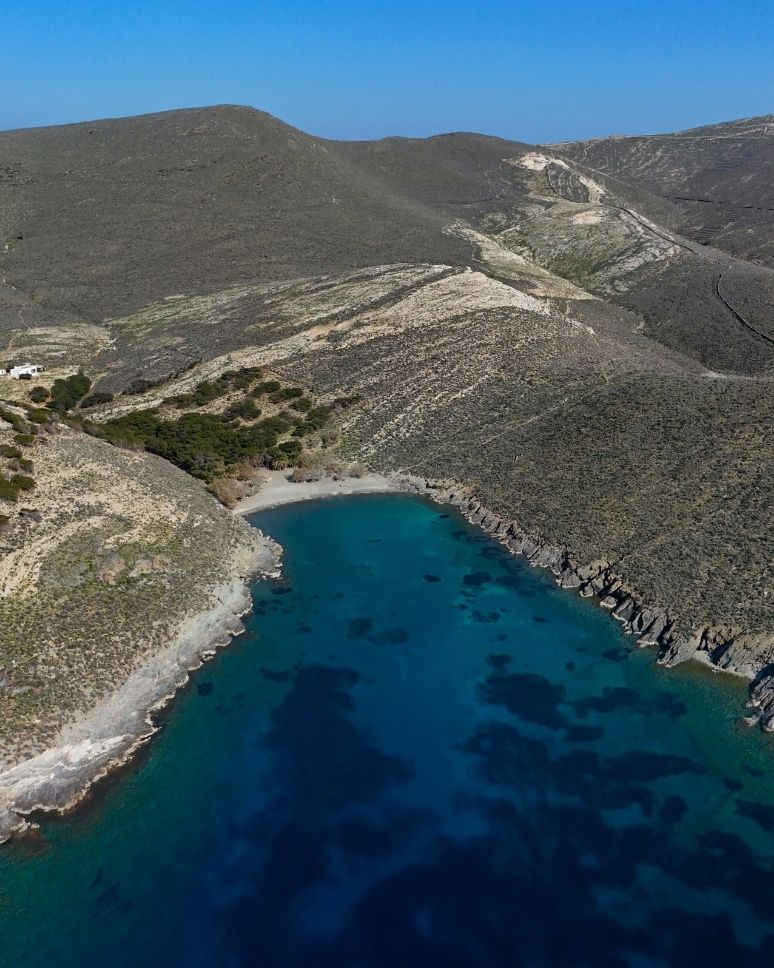
- Kampos – Marmari: About 1 hour 10 minutes, leading to Marmari Beach, a secluded bay with clear waters and steep cliffs around it.
- Kampos – Lia Beach: Roughly 1 hour, an easier trail to a beautiful sandy beach with transparent turquoise waters and panoramic views.
Read more: Best hikes in Syros
Discover Grammata and its ancient inscriptions
Grammata (meaning “letters”) is one of the most fascinating spots in Apano Meria. On the rocks just above the small bay, you can see ancient inscriptions carved by sailors and travelers between the 3rd century BC and the 4th century AD. These short texts include names, prayers, and wishes for safe passage, turning the bay into a kind of open‑air epigraphic museum.
Getting there usually involves a hike from Kampos or a boat trip from elsewhere on the island, and the beach itself has crystal‑clear water perfect for a cooling swim after you’ve spent time reading the stones.

Join a guided hike & learning experience
If you’d like to go deeper into the region’s geology, plants, and history, consider joining a guided hike with a local organization. Guides based in Kampos and Apano Meria offer low‑impact hiking and learning tours where you can see features like Aerólithos (a unique local geological formation), learn about drystone wall building, and identify local herbs and birds along the trail.
This is a great option if you’re not comfortable navigating alone on remote paths, or if you’re traveling with older kids who enjoy learning on the move (most tours are suitable from around age 7 and up, with moderate difficulty). You can book your guide here or get in contact with
Visit San Michalis and tiny northern villages
Beyond Kampos, small villages and hamlets like San Michalis and Finikia show a more traditional, agricultural side of Syros. Here you’ll find terraced fields, stone houses, small churches, and the occasional taverna or farmhouse selling local products such as the famous San Michalis cheese. Walking between these small settlements gives you a feel for how people used to live on these dry slopes.
Even just driving to San Michalis for the view and a simple meal in a local place like Plakostroto (one of our favorite restaurants) can be a memorable “mini‑excursion” from Ermoupoli.
Swim at remote northern beaches
One of the rewards of hiking in Apano Meria is reaching beaches that you can’t drive to. Besides Grammata, trails lead to Marmari, Americanou Beach, and Lia. Don’t expect sunbeds or tavernas; instead, think clear water, pebbles or sand, and maybe a handful of other people, even in high season.
TIP: Always bring your own water, snacks, and a hat when hiking to these beaches, and keep an eye on the time so you can make the return hike with enough daylight.

Practical tips for exploring Apano Meria
A few final, down‑to‑earth tips to make your northern adventure more enjoyable:
- Footwear: Wear proper hiking shoes or sturdy trainers; paths are rocky and loose in places.
- Water & snacks: There are almost no shops once you leave the main road, so carry at least 1.5–2 liters per person for longer hikes, plus salty snacks or fruit.
- Sun protection: Hat, sunscreen, and sunglasses are non‑negotiable, even in spring or on cloudy days – shade is rare up here.
- Navigation: Use a hiking app or offline map and, where possible, follow marked routes.
- Respect: Stay on paths, don’t disturb animals, close gates you open, and leave no litter – Apano Meria is beautiful precisely because it hasn’t been overused.
If you only do one “non‑beach” thing in Syros, let it be a day in Apano Meria. It might not give you a tan, but it will definitely give you a deeper connection to the island.
Read more: What to wear in the Cyclades and Greece: our ultimate packing list
Our honest opinion about Apano Meria

Our Syros Travel Ebook + Google Maps
The ultimate Syros Travel Guide (printable and downloadable on your phone) has ALL the information and inspiration you need to make the most of your Syros trip! From what to do, where to eat, and where to stay, to the best day trips, walks, and hidden gems.
Includes a detailed, interactive, and downloadable Syros Google Maps, with hundreds of pinned places.