
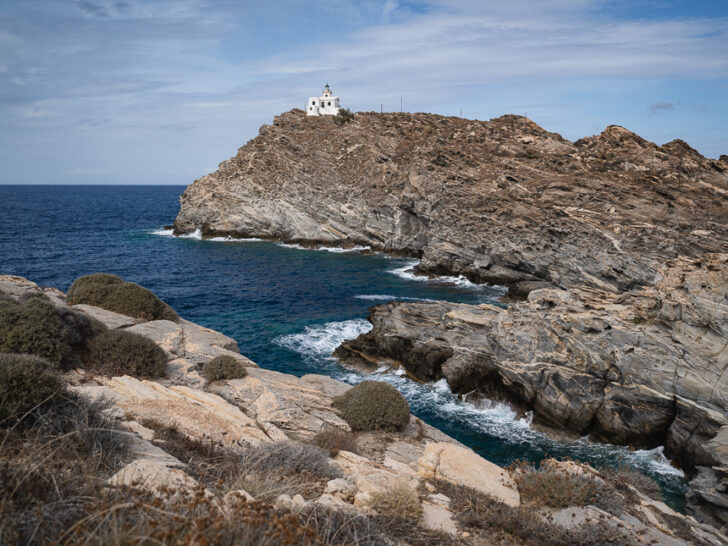
Paros Park is one of the best places on the island for an easy but scenic hike. Located on the Ai Yannis Detis peninsula near Kolymbithres and Naoussa, the park combines dramatic coastal paths, hidden coves, a historic lighthouse, a small monastery and wide-open views across the Aegean Sea.
The walk to the lighthouse was one of our favourite hikes in Paros. It is not a mountain hike and you do not need to be an experienced walker, but it still feels adventurous because the landscape is open, rocky and surrounded by sea. It’s a completely different walk then the Byzantine Road in Lefkes.
We loved the contrast between the easy access and the wild views. Within a relatively short walk, you leave the beach area behind and find yourself on a headland with nothing but the Aegean in front of you. Go early for cooler temperatures or late in the afternoon when the light is softer. The lighthouse is beautiful and also one of the best sunset points in Paros.
The monastery of Ai Yiannis Detis is another beautiful spot in Paros Park and of the best things to do in Paros.

About Paros Park
Paros Park is officially called the Environmental and Cultural Park of Paros and covers around 80 hectares at Ai Yannis Detis. It was created as an environmental and cultural space, with walking trails, nature activities, cultural events and seasonal exhibitions.
The park is one of the first projects of its kind in the Cyclades and relies on volunteer support. Its location is particularly special because the peninsula has both geological and historical importance, while remaining largely natural and undeveloped. There are no hotels in this area.
Unlike a typical landscaped park, this is a rugged coastal landscape. Expect a 7-km walking trail network with 3 well marked walking routes.
Next to the walking trails, you can visit the small Byzantine monastery of Ai Yannis, the 18th-century old Russian gun battery at Cape Tourkos, and the Korakas lighthouse at the northernmost point of Paros. For us, the stunning views of the Aegean Sea and neighboring islands were one of the highlights of our trip to Paros.
Read more: The best things to do in Paros
Where is Paros Park located?
Paros Park is on the north-west coast of Paros, close to Kolymbithres Beach, Monastiri Beach and Naoussa. It is approximately a 10- to 15-minute drive from Naoussa and around 25 to 35 minutes from Parikia, depending on traffic.
The entrance area is close to Monastiri Beach, where you will also find the main parking area and the beginning of the hiking paths. This is also the same parking spot as the beach club “Monastiri”. It is also possible to park next to the Byzantine monasteryg of Ai Yannis. If you’re looking for luch or dinner, you should check the best restaurants in Paros.
In peak summer, especially between late morning and mid-afternoon, it is best to arrive early. The area is popular with beach lovers as well as hikers, and the small roads around Kolymbithres and Monastiri can become busy.

Opening hours and entrance
The walking area is generally accessible throughout the year, and Paros Park is open 24 hours a day. Entrance to the park itself is free.
That said, do not confuse the open hiking paths with the park’s cultural programme. Exhibitions, concerts, and films may follow their own seasonal timetable. The museum is open everyday from 11am to 2pm but closed on Mondays.
Before visiting, especially if you are travelling specifically for a concert, exhibition or event, check the official Paros Park website or contact the park directly.
The hiking trails
Paros Park has several short, interconnected routes rather than one long, continuous hike. They are ideal for who want to walk for 30 minutes, one hour or a relaxed half-day, depending on how many paths and viewpoints you want to combine.
The trails are mostly easy to moderate. The terrain is uneven, rocky and exposed, so proper walking shoes or sturdy sandals are strongly recommended. Do not expect much shade, drinking-water stations or food outlets along the paths.
There are 3 walking main walking trails that you can follow in Paros park.
Route 1: Monastery to Lighthouse
Length: 1,920 m | Duration: 45 minutes (non-stop)
This trail traces the dramatic cliff tops along Paros Park’s northwestern coast, connecting the Byzantine monastery of Agios Yiannis to the Korakas lighthouse at the island’s northern tip.
The walk begins at the monastery courtyard, where a clearly marked signpost across the road points you onto the path. From there, the route crosses a narrow isthmus linking the park to the rest of Paros before turning to follow the rugged coastline. White stones guide you through a series of gentle uphill switchbacks, over a small dry-stone bridge typical of Cycladic architecture, until you reach the cliffs high above the sea near Syra’s Peak.
At Syra’s Peak, the trail splits in two: the blue main route hugs the cliff tops with sweeping views along the western coast, while a red shortcut climbs to the summit of Syra’s Peak itself, rewarding hikers with panoramic vistas across the Aegean toward Syros, Sifnos, and Serifos. Both paths reconnect before a side trail (Route 6) branches off into the Rock Park, a striking landscape of wind- and wave-sculpted rock formations. After about 10 minutes, Route 6 rejoins the main trail, and the lighthouse comes into view across a stretch of turquoise water.
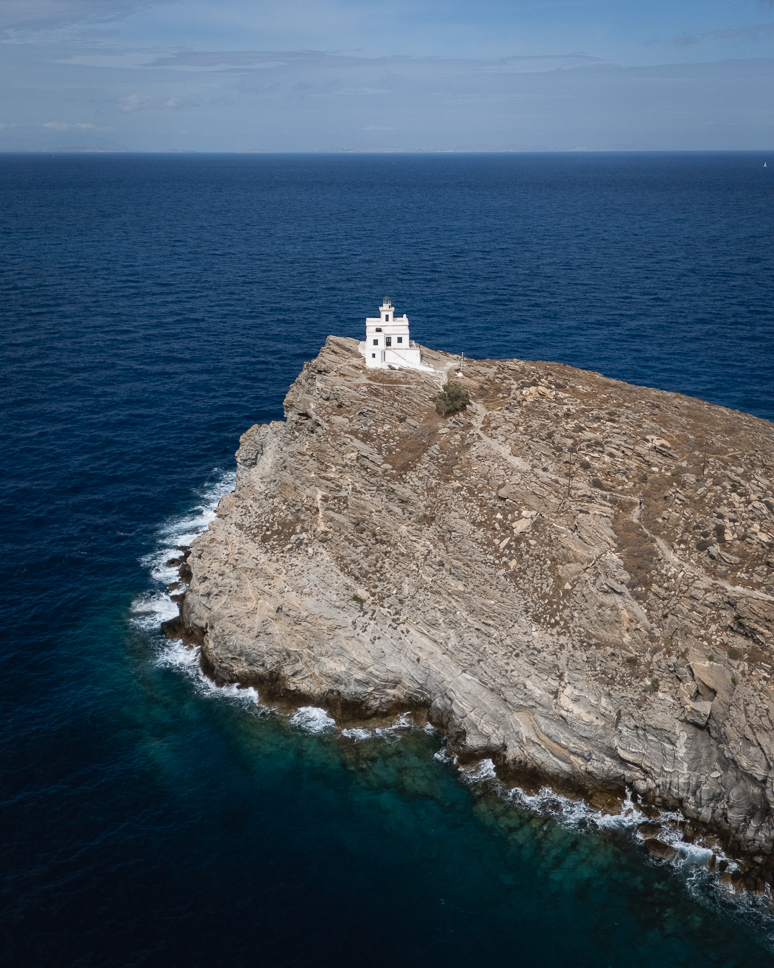
The final stretch curves gently around the bay to the island’s northwestern tip, where a still-functioning lighthouse stands 10 meters above the sea. From here, the views stretch across Mykonos, Delos, Tinos, Syros, and Naxos, along with much of Paros’ northern coastline. A small cave beneath the lighthouse offers welcome shelter from the wind, making it an ideal spot to pause and take in the scenery.

Route 2: Catholicos Beach to Korakas Lighthouse
Length: 1,050 m | Duration: 25 minutes (non-stop)
This shorter trail offers an easy, scenic walk from the sandy shores of Catholicos Beach to the Korakas lighthouse, making it a great option if you’re short on time but still want sweeping coastal views.
The path begins just behind the beach café, on the left side of Paros Park’s main beach, and is easy to follow thanks to clear signage: a yellow “2” inside a small blue circle, with the route bordered by white stones. From the start, the trail winds gently uphill between two small peaks that shelter the area from the prevailing winds. As you round a small hill, the lighthouse suddenly comes into view on your left, a rewarding first glimpse that makes the gentle climb worthwhile.
From here, the path continues through gently undulating terrain that bursts with wildflowers and green bushes outside the summer months, giving the walk a completely different character depending on when you visit. The trail then merges with Route 1 for the final stretch up to Korakas, where the lighthouse stands 10 meters tall and is visible from more than 60 meters away.


Route 3: Catholicos Beach to Tourkou Ammos Loop
Length: 900 m + 1,500 m (2,400 m total) | Duration: 16 + 25 minutes (non-stop)
This is the longest and most varied of the park’s trails, tracing the eastern coastline from Catholicos Beach out to the wild, sheltered sands of Tourkou Ammos and around the headland of Cape Tourkos. Allow around 40 minutes of walking time, though the string of swimming coves along the way makes it easy to turn this into a half-day outing.
The path starts just right of the beach cantina, marked with the same yellow “3 in a blue circle” signage as the rest of the park’s trails, and bordered by white pebbles. Since much of the route hugs the shoreline directly, it’s virtually impossible to lose your way. From the sign, the main path climbs a gentle rocky incline slightly inland, while a red-marked coastal sub-route stays closer to the water, passing a small pier used by a summer water taxi to Naoussa, along with several sheltered coves perfect for claiming your own private swimming spot.
The two paths reunite at Perikopetra beach, a quiet cove with shallow turquoise water ideal for a swim. From there, roughly five minutes further on, the trail passes through Pisses, an area of vividly colored boulders that look almost like natural abstract art. Another 300 meters brings you to Tourkou Ammos, or Turkish Sands, a long, untouched beach shielded from the summer Meltemi winds by Cape Tourkos.
Behind the beach, a pebble-lined path crosses a narrow strip of land onto the cape itself. To the right lies a rocky bay with smooth stones made for sunbathing, while the left-hand path circles the rest of the headland past several small pebble beaches with crystal-clear water. Along the way, a signpost marks the site of a Russian naval base dating to the Russo-Turkish War of 1770–1774, a surprising piece of history tucked into the landscape. From there, it’s a short five-minute walk back around the headland to the beach, where a swim in some of the Aegean’s cleanest water makes for a fitting end to the loop.
If you’re short on time or traveling with young kids, Route 2 is the easiest and fastest, delivering a lighthouse payoff without much climbing. Route 1 rewards a bit more effort with the park’s best panoramic views, especially if you take the red detour up Syra’s Peak. Route 3 is the one to choose if swimming is as much a priority as walking, since it strings together several secluded coves and finishes near clean, sheltered water.
If you want to spend a full day in the park, you can easily combine Route 1 and Route 2 since they share the final stretch to the lighthouse, then save Route 3 for a separate beach-focused outing given its different starting point and swim-friendly pace. Bring plenty of water!


The Monastery of Ai Yiannis Detis
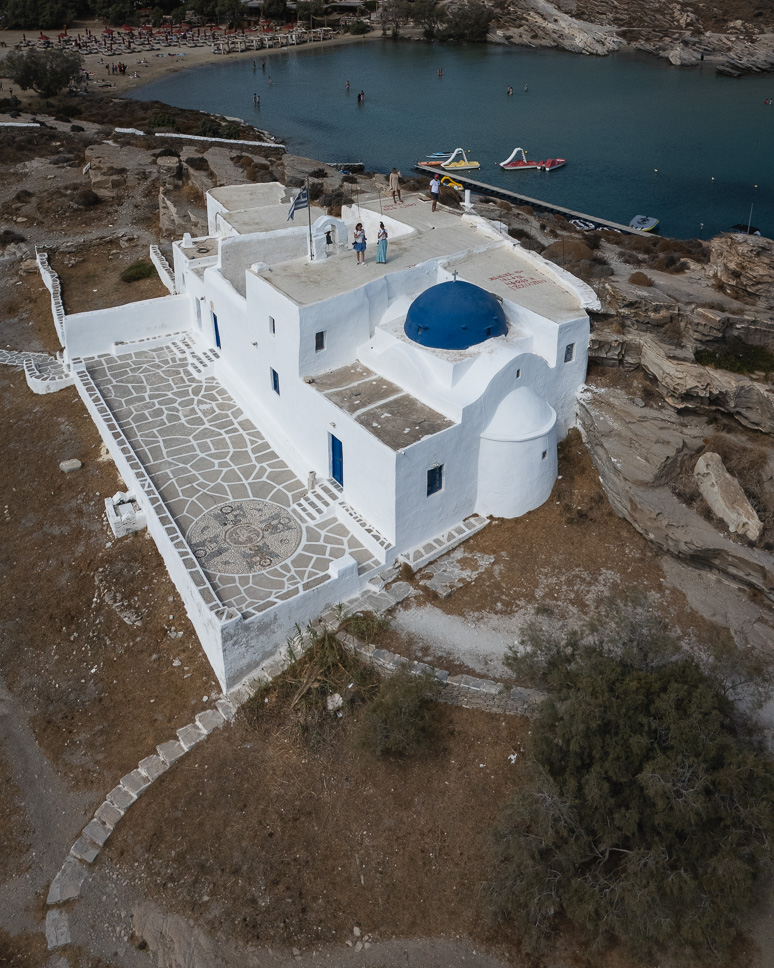
This small Byzantine monastery in Paros Park has a history stretching back to at least 1530, when it first appears under the name Agios Ioannis (Saint John) in old seafaring charts. Russian naval maps from the 1770–1774 occupation of Naoussa Bay show a building on the site, though it’s not confirmed as a monastery until much later.
An inscription records a 1806 renovation by the monk Joseph, and the site once housed a lazaretto, a quarantine station for arriving ships. After Greek monastic laws under King Otto forced the monks out, the monastery sat empty until 1964, when Dutch artist Gizella D’Ailly moved in and restored it, living there on and off until 1982.
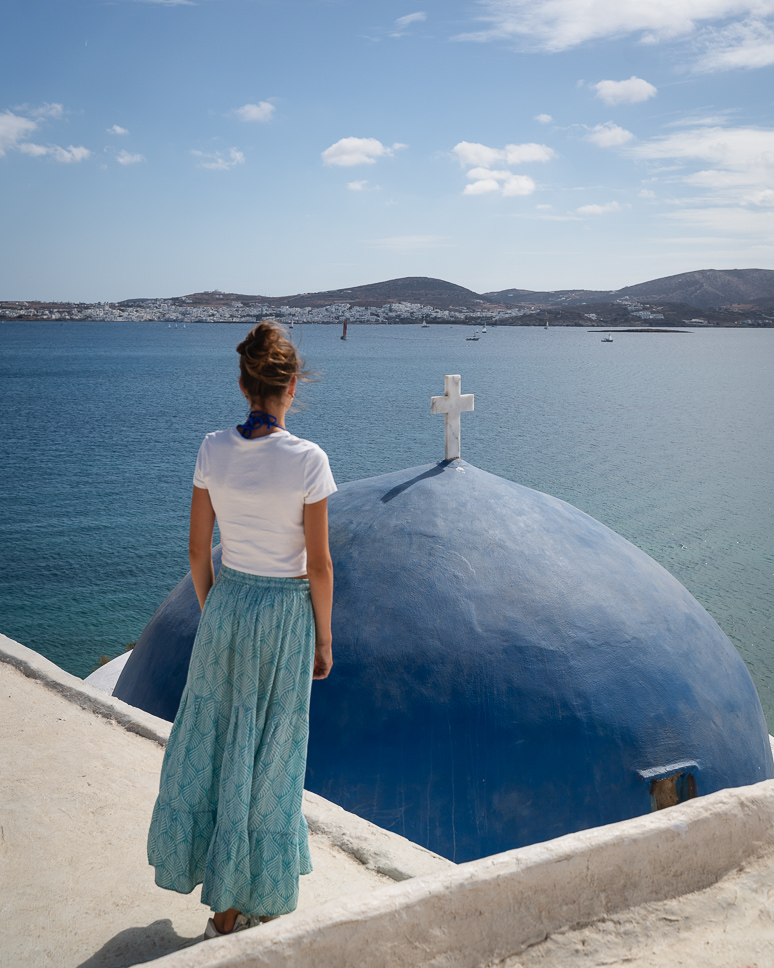
Today, the monastery’s feast day is celebrated every August 29 with an all-night vigil marking the beheading of St. John the Baptist. Its name, “Detis” (meaning “he who ties” or “he who heals”), likely comes either from boats anchoring in its sheltered harbor or from its role in healing Naoussa residents from malaria centuries ago.
With its whitewashed walls set against the deep blue of the Aegean, it’s one of the most Instagram-worthy stops in Paros Park, so keep your camera ready as you pass through on Route 1.
The Beaches in Paros Park
Monastiri Beach
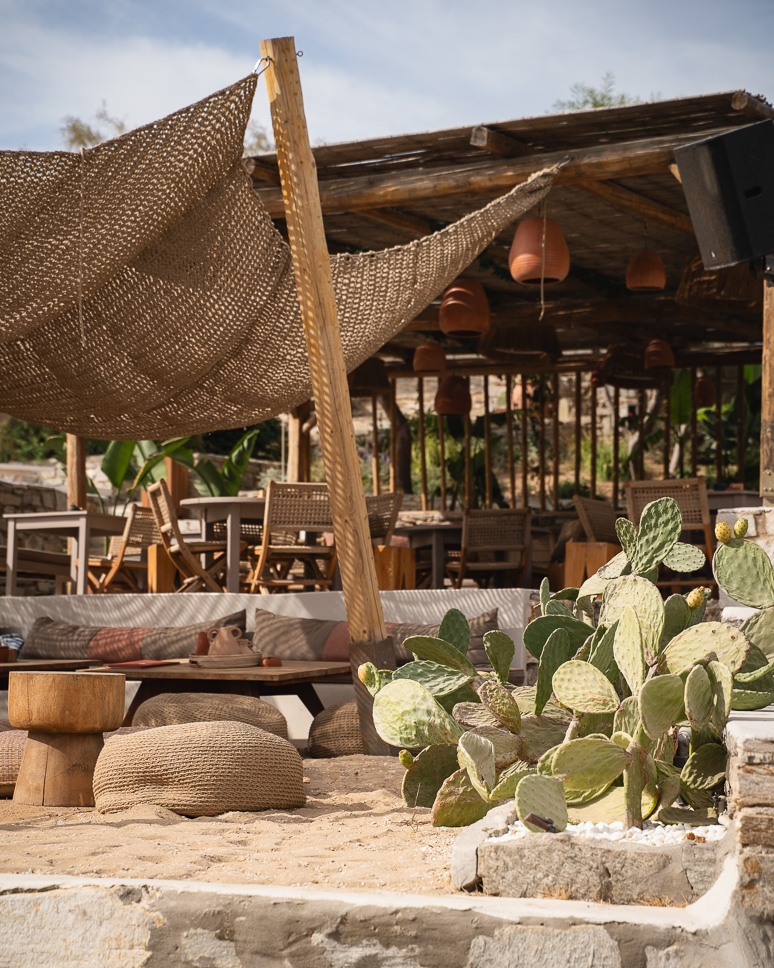
Tucked inside a sheltered cove near the Monastery of Agios Ioannis Detis, Monastiri is the main and most organized beach within Paros Park, near Naoussa. Its wide stretch of soft sand slopes into shallow, crystal-clear water for over 100 meters, making it one of the safest and most family-friendly swimming spots on the island. The beach is equipped with a beach bar offering sunbeds, umbrellas, food, cocktails and water sports like kayaking, snorkeling and paddleboarding, though prices here run a little higher than at more low-key beaches on the island, so it’s worth budgeting a bit extra if you plan to rent a sunbed or eat at the bar.

Perikopetra Beach
A short walk from Monastiri along the marked coastal trail #3, Perikopetra is a small, picturesque cove that feels worlds away from its busier neighbor . There are no sunbeds, no beach bars, and no crowds. Just untouched nature, calm water, and a genuine sense of freedom . It’s completely free to access, making it the perfect budget-friendly alternative if you’d rather skip Monastiri’s pricier beach bar but still enjoy the same protected bay . Bring your own water, snacks and shade, since the park offers no facilities beyond Monastiri .

Tourkou Ammos
Continuing further along the coastal path from Perikopetra, Tourkou Ammos (“Turkish Sand”) is a longer, sandy stretch of shoreline with calm, clear waters, set within the rugged, unspoiled landscape of Paros Park . It’s roughly a 10-15 minute walk from Monastiri and Perikopetra, reachable only on foot via trail #3 . Like the rest of the park’s secluded beaches, it’s completely natural with no facilities, so pack everything you need for the day and enjoy it free of the beach-bar costs found at Monastiri . It’s also known informally as a quieter, nude-friendly spot for travelers seeking real seclusion
FAQ: Frequent Askes Question about Paros Park
What is the best time to hike in Paros Park?
Early morning or late afternoon, for cooler temperatures and better light. Spring and autumn are best overall; in summer, avoid hiking between 11:00 and 16:00.
What should I bring on a hike?
Bring sturdy walking shoes rather than flip-flops, at least one bottle of water per person, and sun protection like a hat, sunglasses and sunscreen. If you plan to visit Monastiri Beach, pack swimwear and a towel too, plus an offline map, a light snack and a charged phone or camera for the viewpoints.
Is Paros Park suitable for children?
Yes, but with supervision. The lighthouse walk has exposed, uneven sections, so it suits kids who are comfortable on natural trails and have proper shoes and sun protection.
What are the best practical tips?
Start from Monastiri Beach, since it’s the easiest access point for parking and the main trails, and take Route 1 to the lighthouse first, as it’s clearer than Route 2. Bring your own water since none is available on the trail, and avoid midday in summer when the sun feels intense. Paros Park pairs well with Kolymbithres or Naoussa as part of a north-Paros itinerary, and the lighthouse cape is worth staying for at sunset.
Is there a beach bar in Paros Park?
Yes, at Monastiri Beach, though it’s a bit pricier than average. Perikopetra and Tourkou Ammos have no facilities at all, so bring your own supplies if you visit them.